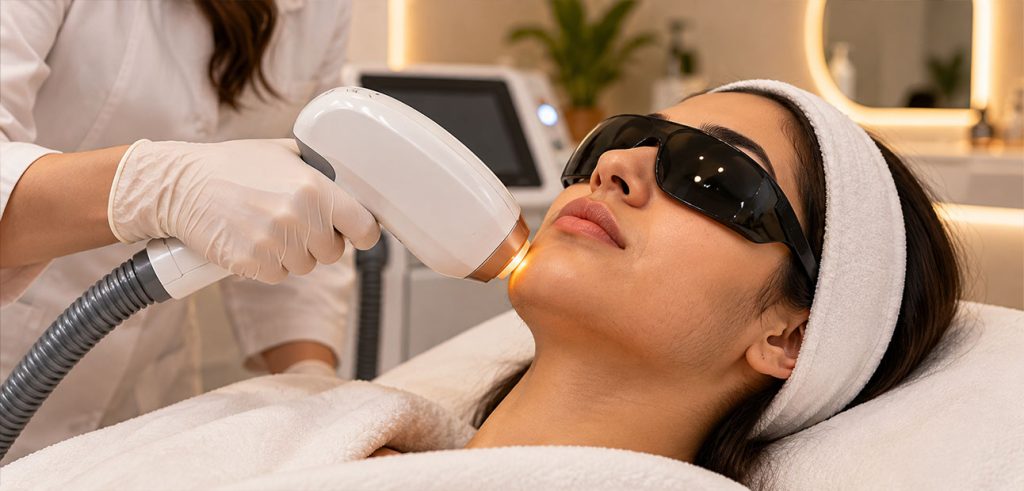
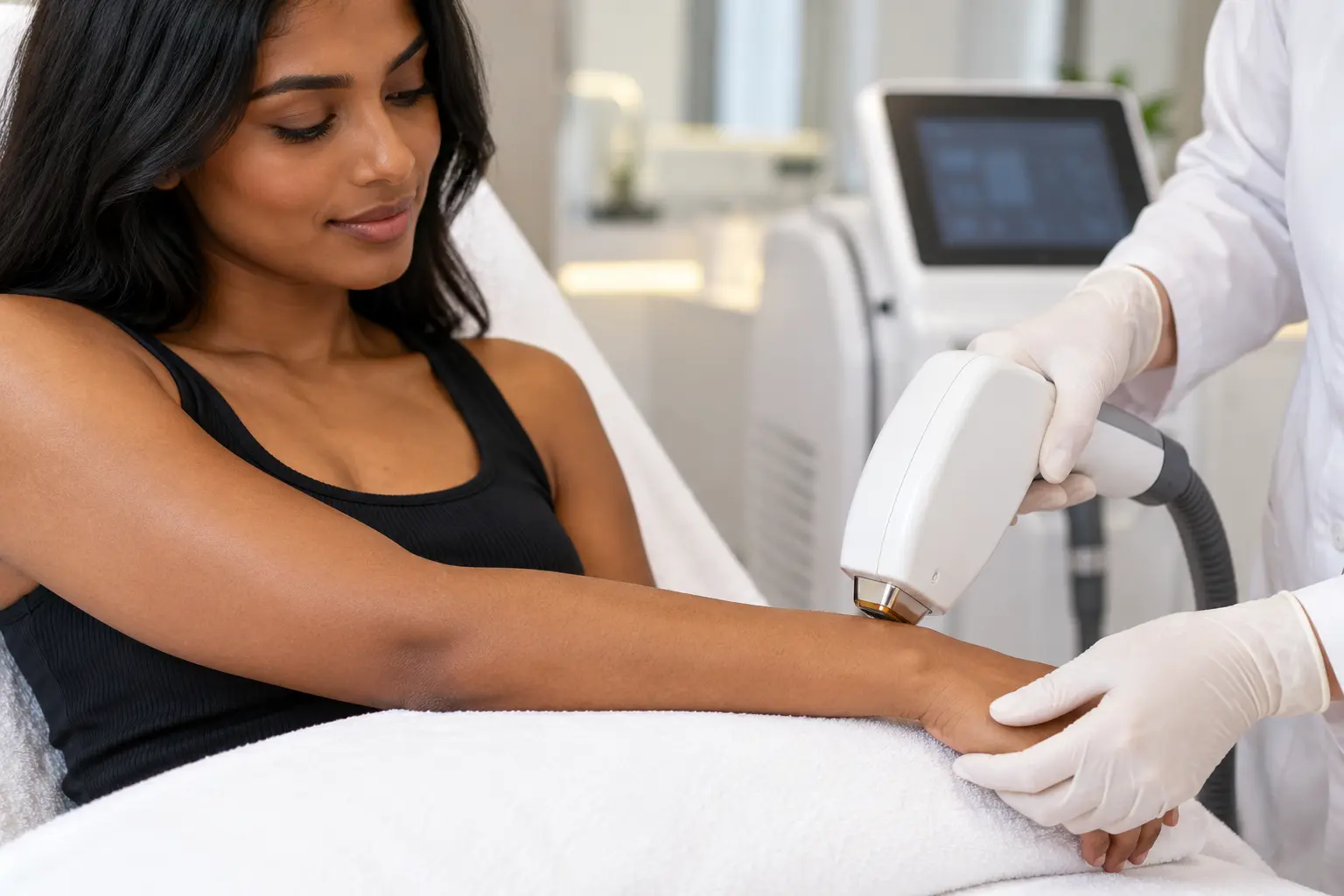
Laser hair removal for dark skin is safe when it is done with a laser suited to deeper skin tones and settings matched to your skin. The long-pulsed Nd:YAG laser is generally considered the safest choice for darker skin, and diode lasers also work well for many brown skin types.
Key takeaways
- Brown skin can be treated safely; the laser and settings make the difference.
- Long-pulsed Nd:YAG and diode lasers are the usual choices for deeper skin tones.
- Dark, coarse hair on brown skin still responds well to laser.
- Most problems on darker skin come from the wrong device, high settings or a fresh tan.
- A test patch helps your doctor find a safe starting point.
If you are weighing up laser hair removal in Karachi, you may have been told it isn’t for brown skin. That advice dates from devices that heated the skin’s own pigment along with the hair. Here is what has changed, and what to ask.
Why is laser hair removal for dark skin different?
The laser targets melanin, and brown skin has more melanin in its surface layer than fair skin. That means the skin can absorb some of the energy meant for the hair, so the device and settings have to be chosen with more care.
Laser light is absorbed by melanin in the hair, turns into heat and damages the follicle, so the hair grows back finer and sparser. On fair skin with dark hair, the hair is the obvious target. On brown skin, the contrast between hair and skin is smaller, which narrows the safety margin.
What your skin type means
Doctors often describe skin using the Fitzpatrick scale. It runs from type I, which always burns and never tans, to type VI, which is deeply pigmented and rarely burns.
Many South Asian skin tones fall somewhere between types III and V. Your exact type matters less than how your skin behaves: whether it tans easily, darkens after a spot or scratch, or has scarred before. In Karachi, where the sun is strong all year, many people carry a light tan without realizing it.
Which lasers are safe for brown skin?
The two lasers most often used for laser hair removal for brown skin are the long-pulsed Nd:YAG and the diode. Both use longer wavelengths that pass through the surface pigment more easily and reach the follicle deeper down.
The Nd:YAG works at 1064 nm, the longest of the common hair-removal wavelengths, so it is usually the first choice for the deepest skin tones. Diode lasers sit around 800–810 nm and suit many light-to-medium brown skin types. The Alexandrite laser, at 755 nm, is better matched to lighter skin, while intense pulsed light (IPL) is not a laser and is generally less suited to darker skin.
Each device has trade-offs, and our guide on which laser is best for hair removal compares them side by side.
Takeaway: The deeper your skin tone, the more the choice of laser and settings matters.
| Skin type (Fitzpatrick) | How it usually behaves | Lasers commonly considered | Points to watch |
| Type III | Light to wheatish; sometimes burns, tans gradually | Diode or Nd:YAG; Alexandrite only with caution | A recent tan raises the risk |
| Type IV | Medium brown; rarely burns, tans easily | Diode or long-pulsed Nd:YAG | Conservative settings and a test patch |
| Type V | Dark brown; very rarely burns | Long-pulsed Nd:YAG preferred; diode with long pulses in experienced hands | Higher risk of pigment change; strong cooling needed |
Local evidence is encouraging. In a 2026 study of 60 women at Dow University of Health Sciences in Karachi, most of them skin type IV, monthly diode laser sessions caused no blisters. Mild redness appeared in about a quarter of the women and soon settled.
How do laser settings protect darker skin?
Settings protect darker skin by heating the hair slowly enough that the surrounding skin can stay cool. The three main levers are pulse length, energy level and cooling.
A longer pulse delivers heat more gradually. The thick hair shaft holds on to that heat, while the thinner layer of pigment in the skin has time to release it. Your doctor may also begin at a lower energy level and increase it over later sessions once your skin has shown how it responds.
Cooling is used during the session to protect the surface of the skin. A test patch on a small area, checked before your first full session, helps confirm the plan.
Does laser work as well on brown skin?
Yes, dark and coarse hair usually responds well on brown skin, because it holds plenty of pigment for the laser to target. Most people need 2 to 6 treatments, usually 4 to 6 weeks apart, according to the American Academy of Dermatology. Settings on brown skin often start conservatively, so your exact number of sessions is set at your consultation.
After each session, treated hairs shed over the following days. Over a course, hair tends to grow back finer and sparser, and treated follicles can eventually stop producing hair. Occasional maintenance sessions may be needed afterwards, and results vary from person to person.
Laser works poorly on fine, light, grey, white or red hair, whatever your skin tone. These hairs have too little pigment for the laser to find.
Who should wait or avoid treatment?
Your doctor will check whether now is the right time, and some people are asked to wait. Treating skin that isn’t ready is the most common route to pigment problems.
You may be asked to wait, or to avoid laser, if you:
- have a tan or sunburn on the area
- are pregnant, as treatment is usually postponed as a precaution
- have an active infection, rash or broken skin where you want treatment
- take medicines that increase sun sensitivity, or have recently taken isotretinoin
- have a history of keloids, which are more common in darker skin
- have melasma or recent dark marks on the face, which your doctor will want to plan around
What are the risks of laser on darker skin?
The main extra risk on darker skin is a change in skin colour. Mayo Clinic notes that this risk is higher in people with brown or black skin, which is why the right laser and settings matter. Post-inflammatory hyperpigmentation, meaning dark marks after irritation, is the most common change, and lighter patches can happen less often.
Burns and blisters are possible if the settings are too strong for your skin. A rare effect called paradoxical hair growth, where hair near the treated area becomes thicker, has been reported more often in darker skin and on the face and neck. For a full rundown of the side effects of laser hair removal, including what is normal, see our separate guide.
Contact your clinic if you notice blisters, crusting, worsening pain or colour changes that don’t fade.
What should you ask at your consultation?
Ask which laser will be used, why it suits your skin type and who will carry out your sessions. A good consultation answers these before any treatment begins.
Your doctor will check your skin tone and hair type, ask about past dark marks, scarring and medicines, and set the laser settings and number of sessions. Useful questions to bring:
- Which laser is this, and what wavelength does it use?
- Will you do a test patch first?
- How will you adjust settings if my skin reacts?
- What aftercare and sun protection should I follow?
How SK’N Theory approaches laser hair removal for dark skin
At SK’N Theory, treatment for brown and darker skin starts with a doctor-led assessment of your skin tone, hair type and any history of pigmentation or scarring. The clinic uses laser technology suited to South Asian and darker skin tones.
Settings and the number of sessions are planned around your skin rather than a standard chart. Cooling is used throughout each session, and you receive aftercare and sun-protection guidance for Karachi’s strong sun before you leave. Follow-up appointments let your doctor check how your skin is responding and adjust the plan.
Book a consultation: If you have been told laser isn’t right for brown skin, it’s worth a proper assessment. Message or call us on WhatsApp 0300 702 2061 (Mon–Sat 10am–8pm, Sunday by appointment).
Frequently asked questions
Will laser hair removal make my skin darker?
It can, but careful settings and sun protection make it less likely. Darkening usually shows as patches after irritation and often fades over time, though on brown skin this can take a while. Tell your doctor straight away if you notice dark marks, so your settings can be adjusted at the next session.
Can I have laser on my face if I have brown skin?
Yes, the upper lip, chin and cheeks are commonly treated on brown skin. Facial skin can be more prone to pigment problems such as melasma, so your doctor will check carefully before treating. Good sun protection on the face between sessions matters even more in Karachi’s year-round sunshine.
Is laser better than threading or waxing for brown skin?
For many people, yes, over the long run. Frequent threading and waxing can irritate brown skin and leave dark marks or ingrown hairs, while laser reduces regrowth over a course of sessions. During treatment, you will be asked to stop threading and waxing, but shaving between sessions is usually fine.
Can laser help with ingrown hairs and dark bumps?
Laser often helps, because fewer and finer hairs mean fewer hairs curling back into the skin. Over time, this can reduce the bumps and dark marks ingrown hairs leave behind. Existing marks may need separate treatment, which your doctor can discuss once your skin has been assessed.
How can I tell if a clinic’s laser suits my skin?
Ask for the name of the device and its wavelength, and whether it is designed for darker skin types. A doctor-led clinic should explain its choice, offer a test patch and adjust settings to your skin. Be cautious if no one asks about your skin type or past reactions.
Not sure what your skin needs?
Book a consultation at our Clifton clinic and our doctors will build a plan around your skin.