Laser hair removal for PCOS can reduce coarse, dark facial and body hair, but it usually needs more sessions and regular maintenance than standard treatment. That’s because the hormones behind PCOS keep prompting new hairs to grow, so laser works best alongside medical care for the hormonal side.
Key takeaways
- Laser treats the hair, not the hormones that drive it.
- With PCOS, expect more sessions than usual and ongoing top-ups.
- Coarse, dark hair responds best; fine or light hair responds poorly.
- New or fast-worsening hair growth should be checked by a doctor first.
If you live with PCOS in Karachi, you may know the routine well: regular threading, a razor in your bag, and a dread of harsh bathroom lighting. A course of laser hair removal treatment can ease that cycle, though it works a little differently when hormones are involved.
What is hormonal facial hair?
Hormonal facial hair is coarse, dark hair that grows in places where men typically grow hair, such as the upper lip, chin, jawline and neck. Doctors call this pattern hirsutism, and it is common.
It is driven by androgens, often called “male” hormones, which every woman makes in small amounts. When androgen levels or the follicles’ sensitivity to them are higher, fine, soft hairs can turn into thick, dark ones. Besides the face, this can show up on the chest, stomach, lower back and inner thighs.
Polycystic ovary syndrome (PCOS) is one of the most common causes of hirsutism. An estimated 10–13% of women worldwide have PCOS, and up to 70% of them don’t know it, according to the World Health Organization. PCOS is not the only cause, though, which is why the reason behind your hair growth needs to be confirmed by a doctor.
How does laser hair removal for PCOS work?
It works the same way as any laser hair removal: light is absorbed by melanin in the hair, turns into heat and damages the follicle. The difference with PCOS is that hormones can keep waking up new follicles after treated ones have slowed down.
PCOS hair is often coarse and dark, which makes it a good target for laser. Over a course, treated hair tends to grow back finer and sparser, and treated follicles can eventually stop producing hair. Laser does nothing to the hormone levels themselves.
Why does PCOS hair need more sessions?
PCOS hair needs more sessions because the hormonal signal behind it doesn’t switch off when the laser clears an area. New hairs can keep appearing, so the plan has to account for them.
Takeaway: Laser clears the hair you have now; hormones can keep producing new hair.
| What’s happening | Why it matters for laser | What it means for your plan |
| Androgens keep turning fine hairs into coarse ones | Areas you’ve treated can sprout new hairs later | More sessions than a standard course |
| Hair grows in cycles, and laser mainly affects actively growing hair | Each session only catches part of the hair present | Sessions spaced several weeks apart |
| The chin and neck often have a mix of coarse and fine hair | Fine, light hairs absorb little laser energy | Some hairs may need another method |
| Hormone levels can shift with weight changes, medicines or pregnancy | Growth can pick up again months or years later | Maintenance sessions at intervals your doctor sets |
For general guidance on how many laser sessions most people need, see our separate guide. The American Academy of Dermatology says most patients need 2 to 6 treatments, usually 4 to 6 weeks apart, with maintenance sessions to keep the area clear. With PCOS, expect your plan to sit at the longer end, with the exact number set at your consultation.
Why does treating the hormones matter too?
Treating the hormones slows down new growth, while laser clears the hair that is already there. Many doctors combine the two for this reason.
Depending on your health and plans, a doctor may discuss options such as hormonal tablets, anti-androgen medicines or a prescription cream that slows facial hair growth. Some of these are not suitable during pregnancy or when trying to conceive, so the choice belongs with your doctor. Where it is relevant, lifestyle changes such as weight management, regular activity and better sleep can also help PCOS symptoms.
Combining treatments can speed things up. In a 2026 study of 60 women with excess hair at Dow University of Health Sciences in Karachi, 73% of those who added eflornithine, a prescription cream that slows hair growth, to monthly diode laser had a good response after three sessions, compared with 43% on laser alone. By the sixth session, results in the two groups were similar.
Who is laser suitable for, and who should wait?
Laser suits you best if your unwanted hair is dark and coarse and you are happy to commit to a longer plan. Your doctor will check whether now is the right time.
You may be asked to wait, or to avoid laser, if you:
- are pregnant, as treatment is usually postponed as a precaution
- have active acne, an infection or broken skin on the area
- take, or have recently taken, isotretinoin for acne, or other medicines that make skin sun-sensitive
- have a tan or sunburn where you want treatment
- tend to form keloids or raised scars
- have new hair growth that hasn’t yet been checked by a doctor
What results can you realistically expect?
Most people with PCOS see a clear reduction in hair, with what remains growing finer and lighter. Complete, lasting clearance is less likely than with non-hormonal hair, and results vary from person to person.
You’ll usually notice treated hairs shedding over the days after each session. Over the course, you should need to thread or shave less often.
For many people, the biggest change is in comfort: fewer threading appointments and less of the irritation, bumps and dark marks that frequent threading can leave on brown skin. Our guide that answers is laser hair removal permanent explains the difference between hair reduction and hair removal in more detail.
What are the risks and side effects?
Most people only have mild redness and swelling around the follicles, which settles within hours. More serious problems, such as burns or patches of darker or lighter skin, are uncommon with the right settings.
One rare effect is worth knowing about with PCOS. Paradoxical hair growth, where hair near the treated area becomes thicker, has been reported more often on the face and neck and in people with hormonal conditions. Tell your doctor if you notice anything like this.
What happens at your consultation?
Your consultation looks at the whole picture, not just the hair. The doctor checks your skin tone and hair type and asks about your periods, any PCOS diagnosis, medicines and past hair-removal methods. It helps to bring a list of any medicines and supplements you take.
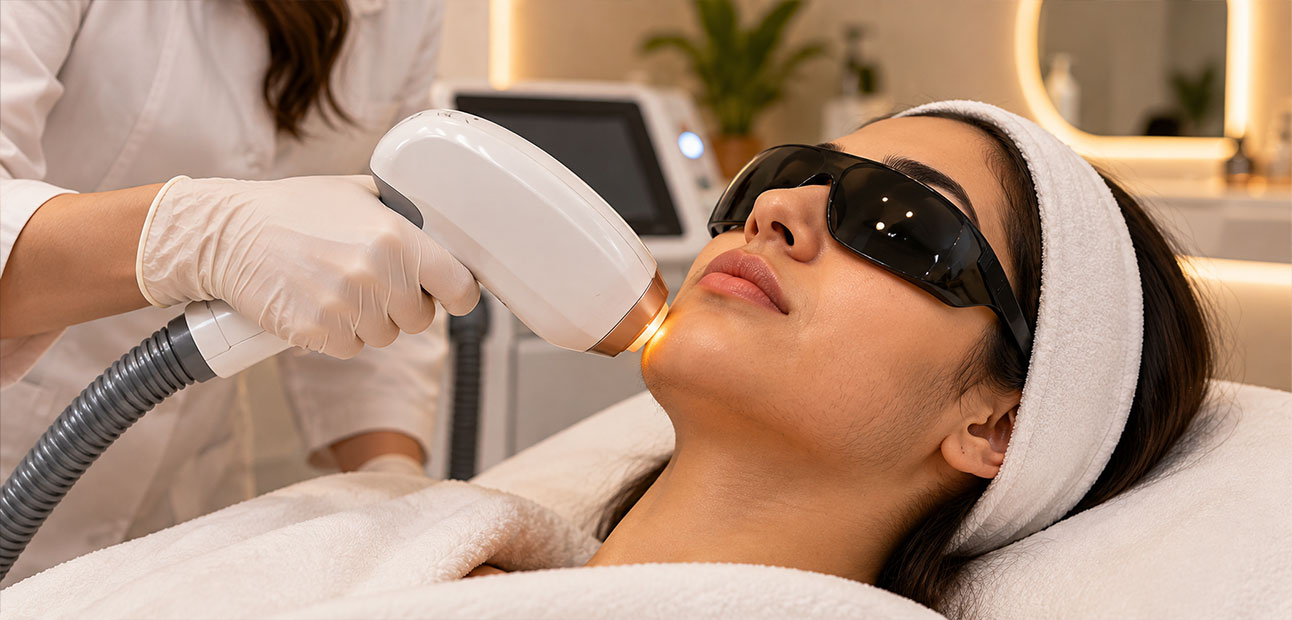
If your symptoms haven’t been looked into yet, you may be advised to see a doctor for that first. From there, the laser settings and number of sessions are planned around your skin and your hormones. Cooling is used during each session, and most people describe the feeling as a mild rubber-band snap.
When should you see a doctor about excess hair?
See a doctor if unwanted hair comes with other changes, such as irregular or missed periods, persistent acne, thinning hair on the scalp or unexplained weight gain. Dark, velvety patches on the neck or underarms are also worth mentioning.
Seek prompt medical advice if hair growth appears suddenly or worsens quickly, or if you notice a deepening voice. These changes need checking before any cosmetic treatment.
How SK’N Theory approaches laser hair removal for PCOS
At SK’N Theory, laser for PCOS-related hair is planned by doctors who look at your overall health as well as your skin. Dr. Saba Jerjees, an aesthetic physician with a family-medicine background, takes a holistic approach, considering lifestyle and nutrition alongside in-clinic care.
Your skin tone and hair type are assessed first, and the clinic in Clifton, Karachi, uses laser technology suited to South Asian and darker skin tones. Your plan sets the number of sessions and allows for maintenance from the start. Follow-up visits track how your hair is responding, and you are encouraged to keep the hormonal side under medical care.
Book a consultation: If hormonal hair is taking up too much of your time, message or call us on WhatsApp 0300 702 2061 (Mon–Sat 10am–8pm, Sunday by appointment). We’ll talk through your history and build a realistic plan.
Frequently asked questions
Do I need a PCOS diagnosis before starting laser?
Not always, but it helps. If your hair growth comes with irregular periods, acne or other changes, a check with a doctor first makes sense. Knowing what is driving the hair lets your laser plan allow for it, and means any underlying condition gets the medical care it needs.
Should I stop threading before my laser sessions?
Yes. Threading, waxing and plucking pull out the root, which is the part the laser needs to target. Many clinics ask you to stop several weeks before your first session, and your doctor will give you the exact timing. Shaving or trimming between sessions is usually fine, because it leaves the root in place.
Can laser remove the fine hair on my chin and upper lip?
Laser works well on coarse, dark hairs but poorly on fine, light ones. Many people with PCOS have a mix of both on the chin and upper lip. Your doctor will look at your hair closely and explain which hairs are likely to respond and which may need another approach.
Will my hair come back if I stop my PCOS medicine?
Hormone-driven growth can increase if the hormones are no longer controlled, and new hairs may appear in treated areas. Maintenance sessions can help keep them in check. Never stop a prescribed medicine on your own; speak to the doctor who prescribed it about any changes you are considering.
Can I have laser if I am trying to get pregnant?
Talk to your doctor first. Laser is usually postponed during pregnancy as a precaution, and some PCOS medicines are not suitable when you are trying to conceive. Your doctor can help you time sessions around your plans so your treatment and family planning work together.
Not sure what your skin needs?
Book a consultation at our Clifton clinic and our doctors will build a plan around your skin.